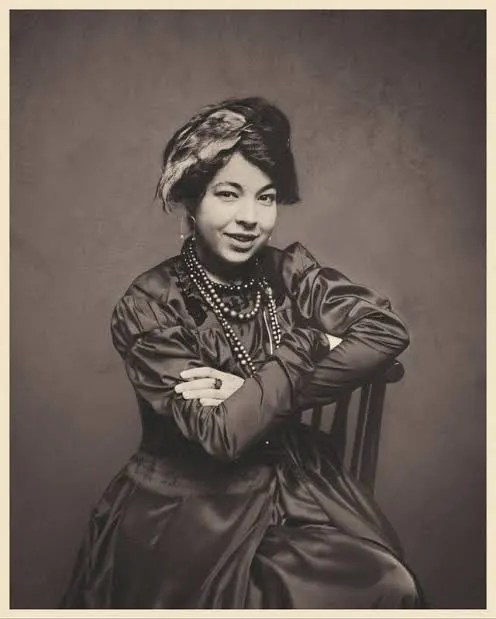
Most people who know tarot know her work, even if they do not know her name. Pamela Colman Smith, the artist behind what is now commonly called the Rider-Waite-Smith deck, created one of the most influential visual languages in modern mysticism. For decades, the deck was usually discussed under Waite’s name and the publisher’s name, while Smith herself was pushed to the edge of the story. Scholars now treat that omission as part of a larger pattern of gendered erasure, and many readers have deliberately shifted to calling the deck Rider-Waite-Smith or Waite-Smith to restore her place in its history.
Pamela Colman Smith, who lived from 1878 to 1951, was far more than a tarot illustrator. She was an artist, writer, editor, folklorist, publisher, performer, and designer whose life moved across London, Jamaica, New York, and back to London again. She studied at Pratt Institute under Arthur Wesley Dow, absorbed Arts and Crafts and Symbolist influences, wrote and illustrated Jamaican folktales, and worked in theater through costume, set, and storytelling traditions. That wide creative life matters, because her tarot art did not come out of nowhere. It came out of someone already thinking in symbols, performance, rhythm, folklore, and image.
She was also a woman trying to make art and earn authority inside systems that were not built for her. One of the clearest examples is The Green Sheaf, the magazine she founded and edited, and the Green Sheaf Press that followed. Scholars describe The Green Sheaf as remarkable for its female leadership in a male-dominated little-magazine world, and as a space where Smith promoted women and gender-nonconforming creators, artisanal labor, and alternative creative networks. In other words, long before people started calling her a visionary tarot artist, she was already building her own feminist counter-space in print.
Her most famous project began through the Hermetic Order of the Golden Dawn, where she crossed paths with Arthur Edward Waite. In 1909, she illustrated the deck that would become the most recognizable tarot deck in the world. What makes her contribution so revolutionary is not only that the deck became famous, but how she changed tarot’s visual grammar. The V&A notes that this was the first deck with fully illustrated pip cards that could be read intuitively. Waite gave close instructions for the Major Arcana, but Smith had far more freedom with the Minor Arcana, and that is where her imagination changed tarot forever. Instead of scattered suit symbols, she gave readers scenes. Narrative. Emotion. Atmosphere. Human stakes.
That is also where a feminist reading becomes especially compelling. We should be careful here: not every symbol in the deck can be claimed as Smith’s personal manifesto, especially in the Major Arcana, where Waite’s influence was stronger. But scholars have explicitly connected Smith’s suffrage work to her tarot imagery and her representations of women, and we know she was active in the women’s suffrage movement through the Suffrage Atelier around the same period the deck was created. So while we cannot prove that every choice was consciously feminist, there is strong reason to read her work through that lens.
One place I feel that feminist touch most strongly is in the dignity of her figures. Smith’s women are not just decorative ideals placed around male power. They often appear as authorities, guardians, actors, and interpreters of mystery. Even outside the tarot, this pattern shows up in her broader work. Artnet notes that in her Annancy Stories she sometimes gave women more agency and even made gender ambiguous. In the tarot, that same instinct seems to surface in cards where feminine figures hold knowledge, restraint, intuition, sovereignty, and spiritual force without apology. Her imagery does not always overthrow patriarchy head-on, but it often quietly reroutes authority through women’s bodies, gestures, and inner worlds.
Another feminist move may be hiding in plain sight: Smith made everyday human experience worthy of symbolism. The Minor Arcana in older decks often remained abstract. Smith filled them with labor, grief, tension, celebration, poverty, patience, travel, conflict, and care. That choice makes the deck feel less like a system owned by elite male occultists and more like a living theater of ordinary experience. It is one reason her cards still feel startlingly modern. They do not only depict cosmic ideas. They depict what it feels like to be a person moving through the world.
Her lasting impact is enormous. The Whitney notes that the deck is still the most popular tarot deck in use, with an estimated one hundred million copies in circulation, and museums and scholars now increasingly recognize that many later decks inherit Smith’s visual logic even when they radically change the style. The deck’s continuing power is not just historical. It is artistic. Smith made tarot legible to the modern eye. She made symbolism narrative. She made divination visual. She made the cards emotionally readable. That is why so many contemporary decks, whether they know it or not, are still speaking her language,
Pamela Colman Smith’s real legacy is bigger than being “the woman who illustrated a famous deck.” She was a world-builder. A visual storyteller. A maker of feminist spaces. A woman who carved authority for herself in publishing, performance, occult art, and design, even when the culture around her kept trying to hand the credit elsewhere. The more we learn about her, the more the history of tarot starts to look less like a story about a male occultist commissioning images, and more like a story about a brilliant artist transforming an entire tradition from the inside.
 Miranda Levi
Leave a comment